5 Ways Debt Can Affect Your Mental Health
Debt doesn’t just affect your finances. Research shows financial stress can impact your sleep, mental health and relationships. Here are five ways debt may be affecting your well-being.

Financial Wellness Writer & IAPDA-Certified Consumer Debt Editor, Beyond Finance
Molly Simon is a financial wellness writer and IAPDA-Certified, AFCPE-trained Consumer Debt Editor at Beyond Finance, where she covers the emotional, behavioral, and practical dimensions of financial health for everyday Americans navigating financial stress and debt.
A Career Focused on Financial Wellness and the Human Side of Money
With nearly a decade of experience writing about consumer financial topics, Molly has built a reputation as a grounded, empathetic voice in the personal finance space. Her work goes beyond the numbers — exploring how financial stress shapes identity, relationships, and mental health, and what it actually takes to build lasting financial wellness from the inside out.
At Beyond Finance, one of the nation's largest and most decorated debt consolidation companies, Molly focuses on making financial wellness content genuinely accessible — the kind of writing that meets people where they are, without judgment, and helps them take their next step with confidence.
Areas of Expertise
Molly writes at the intersection of financial behavior and emotional wellbeing. Her work covers:
Education & Professional Certifications
Molly holds two Bachelor of Arts degrees from Lewis & Clark College — in German Studies and History — and is certified by the International Association of Professional Debt Arbitrators (IAPDA), giving her a formal, industry-recognized foundation in consumer debt and debt consolidation.
Media Placements
Molly's work has been featured and syndicated across major media outlets including AOL, Newsweek, and MSN, reaching audiences navigating financial stress and looking for honest, actionable guidance.
Mission & Philosophy
Molly believes that financial wellness is as much an emotional journey as a practical one. The shame and stigma that surround financial hardship are real — and they're barriers to recovery that deserve to be named and dismantled, not ignored. Her writing is grounded in the belief that financial struggles don't define a person's character or worth, and that everyone deserves access to resources that are honest, approachable, and genuinely useful.
She is particularly drawn to the places where financial stress and mental health intersect — the anxiety of debt, the identity disruption of financial hardship, the family dynamics that money conversations can fracture or heal. These are the human stories behind the financial statistics, and they're the stories Molly is most committed to telling well.
Outside of Work
Based in the Chicago area, Molly can be found biking around Chicagoland, flexing her green thumb in her vegetable garden, or with her nose stuck in a history book.
Molly's articles on this site reflect her own research and expertise. For personalized financial advice, consult a licensed financial professional.

Debt doesn’t just affect your finances. Research shows financial stress can impact your sleep, mental health and relationships. Here are five ways debt may be affecting your well-being.

Reviewed by Dr. Erika Rasure, PhD, CFT™ The time-honored ritual of spring cleaning doesn’t have to be restricted to decluttering your closet or deep-cleaning your kitchen. In fact, doing a bit of financial spring cleaning can make a major impact on your finances the rest of the year — and…

Debt consolidation is a great first step toward a better, more stable financial future. And doing your homework before starting a program is a smart move, too — learning how a debt consolidation program can lower your monthly payment, simplify your bills and get you out of debt faster is…
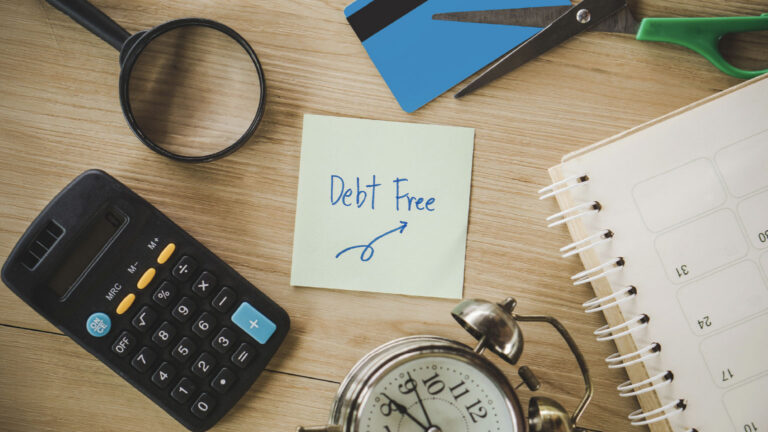
When working through overwhelming debt, it can feel like running on a treadmill — you’ve been putting in the effort, but you never feel like you’ve moved forward. That frustration can derail your determination to get debt-free. And while it’s natural to fantasize about waking up tomorrow morning to find…

Debt consolidation might be a great solution to getting free from debt, but it’s not a magic bullet. And that’s a good thing. Debt consolidation can take time, typically about 24-48 months. And while you’ll get to enjoy lower monthly payments and simplified bills, the time you spend in the…

It’s no secret that debt changes things. It might change your budget, future plans and — maybe most importantly — the way you feel about yourself. Managing multiple high-interest debts can make you feel overwhelmed. And getting stuck in a cycle of stress can quietly chip away at your confidence…

Reviewed by Dr. Erika Rasure, PhD, CFT™ Debt isn’t uncommon — and nor are the feelings of stress, shame and self-criticism that come with it. In fact, the way that debt impacts your mental health could actually keep you in repayment longer. But there are ways to counter the feelings…

If you’ve ever felt your shoulders tighten just thinking about bills, you’re not alone. Money touches almost everything — our sleep, our appetite, our relationships, even how hopeful we feel about the future. But many people don’t talk about the opportunity cost of debt — that is to say, that…

Reviewed by Nathan Astle, CFT-I™ It’s hard to watch someone you care about struggle financially, and deciding to help is an admirable thing. But do you and your loved one a favor: Be clear about the level of help you can afford. This article will cover why it’s smart to…

Reviewed by Dr. Erika Rasure, PhD, CFT™ In the beginning, social media was a place to people-watch, interact and reconnect. But that initial premise was soon infused with money — and now, 70% of all active Instagram users shop on the platform. That means that using social media is no…
We use tracking technologies to improve your user experience and analyze performance on our site. We may share some of this information collected with our partners. If you opt out, we will not use your information. If you do not make a selection, you agree to our use of these technologies. Privacy Policy